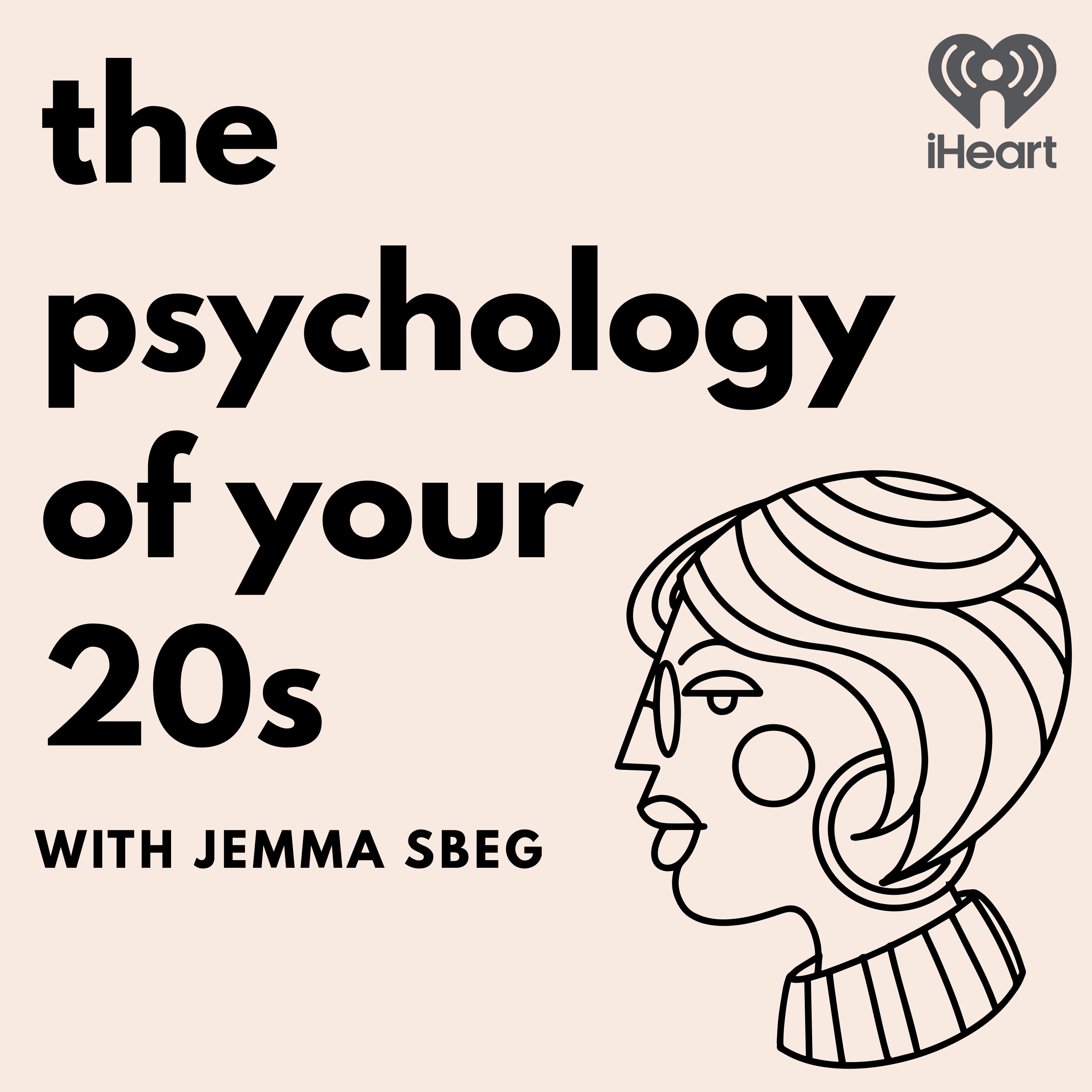
The Psychology of your 20s
iHeartPodcastsAudio
- Format:
- Podcast
- New episodes:
- Several times a week
- Typical length:
- about 40 minutes
- Latest episode:
About this show
A podcast that explains how everything is psychology. Even your 20s. Hosted by Jemma Sbeg, each Tuesday and Friday we deep dive into the science and psychology behind a topic, concept or universal experience that defines our 20s - from dating, to mental health, career anxiety, friendship, finances and all the growing pains associated with this decade. Listen now.
Watch on Netflix: HERE
Follow Jemma on Instagram: @jemmasbeg
Follow the podcast on Instagram: @thatpsychologypodcast
Subscribe on Substack: @thepsychologyofyour20s
For business: psychologyofyour20s@gmail.com
Covers: psychology, relationships, young adults, mental health, personal finance, career anxiety, self improvement, behavioral science
Show details and episodes come from the publisher's public feed at omnycontent.com. Last updated . Names, artwork and text belong to their publishers.
Recently on this show
Summary of recent episodes, drawn from the publisher's feed.
This podcast uses psychology research to examine experiences that shape life in your twenties, such as dating, mental health, career worries, friendship and money. Recent episodes ask why people stay in wrong relationships, whether love is just brain chemistry, and how cognitive biases can steer decisions.
Cosmos
Rated alike
- Laura Farms
Often rated the same way. - Self Sufficient Me
Often rated the same way. - The Carpool with Kelly and Lizz
Often rated the same way.
Similar in subject
- Call Her Daddy
Both cover: self improvement, psychology, relationships - The Happiness Lab with Dr. Laurie Santos
Both cover: behavioral science, psychology, relationships - How To! with Charles Duhigg
Both cover: self improvement, psychology, relationships
Similar shows





Explore more
Episodes
483. The psychology of crying
· 37 min
Why do we cry? What kind of practical purpose does it serve? Does it really make us feel better, or is that just a load of pseudoscience? In this episode, we break down the psychology of crying. We look at why humans might have evolved to cry emotional tears, what those tears communicate before we’ve said a word and why we sometimes feel better after a good cry. Watch on Netflix: HERE (https://netflix.com/thepsychologyofyour20s) We also get into the research behind: - How tears change the way other people see and respond to us - What happens in our nervous system during and after a big cry - Why anger and small frustrations can tip us over the edge - Kama muta, the feeling of being moved by a sudden sense of closeness - Why we sometimes can’t cry, even when we really want to Happy (sad?) listening! Follow Jemma on Instagram: @jemmasbeg (https://www.instagram.com/jemmasbeg/?hl=en#) Follow the podcast on Instagram: @thatpsychologypodcast (https://www.instagram.com/thatpsychologypodcast/?hl=en#) Subscribe on Substack: @thepsychologyofyour20s (https://substack.com/@thepsychologyofyour20s) For business: psychologyofyour20s@gmail.com The Psychology of your 20s is not a substitute for professional mental health help. If you are struggling, distressed or require personalised advice, please reach out to your doctor or a licensed psychologist. See omnystudio.com/listener (https://omnystudio.com/listener) for privacy information.
Not rated yet482. Why do we stay in the wrong relationships?
· 41 min
Why do we stay in relationships we know aren’t right for us? Why do we keep giving chances, waiting for someone to change or believing that leaving would be worse than being unhappy? Watch on Netflix: HERE (https://netflix.com/thepsychologyofyour20s) Today, we explore the psychology behind staying, from romantic relationships to friendships and family dynamics. We discuss: - How our early relationship blueprints shape what we accept - Why we fall in love with someone’s potential - The sunk cost fallacy and fear of starting again - How unhappy relationships can erode our self-esteem - Five questions to help you reflect on whether to stay or leave - How to give your own future the optimism you keep giving someone else If you’ve ever wondered, “Why can’t I just walk away?”, this episode is for you. If you or someone you know NEEDS HELP, please find it HERE (https://www.nationaldahelpline.org.uk/) Follow Jemma on Instagram: @jemmasbeg (https://www.instagram.com/jemmasbeg/?hl=en#) Follow the podcast on Instagram: @thatpsychologypodcast (https://www.instagram.com/thatpsychologypodcast/?hl=en#) Subscribe on Substack: @thepsychologyofyour20s (https://substack.com/@thepsychologyofyour20s) For business: psychologyofyour20s@gmail.com The Psychology of your 20s is not a substitute for professional mental health help. If you are struggling, distressed or require personalised advice, please reach out to your doctor or a licensed psychologist. See omnystudio.com/listener (https://omnystudio.com/listener) for privacy information.
Not rated yet481. Is love just a chemical in the brain?
· 30 min
Is love just dopamine and oxytocin, or does that explanation miss something? In today’s bonus episode, we’re debunking the idea that our deepest connections can be reduced to a chemical reaction. We explore: - The chemistry behind lust, attraction and attachment - Dopamine, serotonin, testosterone and oxytocin - Why falling in love can feel so consuming - What pheromones actually tell us about compatibility - Why so much research on bonding comes from prairie voles - Whether we could ever create a love potion or a pill for heartbreak The Debunking Psychology playlist:HERE (https://open.spotify.com/playlist/3v4MCVBZ2itiJweLFzKVmO?si=df2dc9aa4ec04fbd) Happy listening! Watch on Netflix: HERE (https://netflix.com/thepsychologyofyour20s) Follow Jemma on Instagram: @jemmasbeg (https://www.instagram.com/jemmasbeg/?hl=en#) Follow the podcast on Instagram: @thatpsychologypodcast (https://www.instagram.com/thatpsychologypodcast/?hl=en#) Subscribe on Substack: @thepsychologyofyour20s (https://substack.com/@thepsychologyofyour20s) For business: psychologyofyour20s@gmail.com The Psychology of your 20s is not a substitute for professional mental health help. If you are struggling, distressed or require personalised advice, please reach out to your doctor or a licensed psychologist. See omnystudio.com/listener (https://omnystudio.com/listener) for privacy information.
Not rated yet480. The 6 cognitive biases that will ruin your 20s
· 42 min
Your brain doesn’t always steer you towards what’s best for you...especially in your 20s. Sometimes it convinces you to stay in the wrong relationship, give up after one rejection or believe you should have your entire life figured out by 25 even though you know that's not true! Why is that? Watch on Netflix: HERE (https://netflix.com/thepsychologyofyour20s) In today’s episode, we explore six cognitive biases that shape our decisions in our 20s, including: - Why we underestimate how long good things will take - How instant gratification keeps us putting off our goals - Why we keep investing in things we know aren’t right - Why rejection and change rarely feel as bad as we predict - How recent experiences distort our expectations - Why we judge others more harshly than ourselves We also discuss how to catch these biases in action and stop letting automatic assumptions make your biggest decisions. Follow Jemma on Instagram: @jemmasbeg (https://www.instagram.com/jemmasbeg/?hl=en#) Follow the podcast on Instagram: @thatpsychologypodcast (https://www.instagram.com/thatpsychologypodcast/?hl=en#) Subscribe on Substack: @thepsychologyofyour20s (https://substack.com/@thepsychologyofyour20s) For business: psychologyofyour20s@gmail.com The Psychology of your 20s is not a substitute for professional mental health help. If you are struggling, distressed or require personalised advice, please reach out to your doctor or a licensed psychologist. See omnystudio.com/listener (https://omnystudio.com/listener) for privacy information.
Not rated yet479. Why you're not who you want to be (yet)
· 39 min
Most of us have an idea of the person we would like to become - more confident, more successful, healthier, calmer, more disciplined. But where did that ideal come from? And is it actually ours? In this episode, we explore the psychology behind the real and ideal self, asking what happens when the person we are feels increasingly distant from the person we think we should be. Watch on Netflix: HERE (https://netflix.com/thepsychologyofyour20s) We explore: - Where the idea of the real and ideal self comes from - The role of congruence for self-esteem and well-being - How conditions of worth can disconnect us from what we truly want - The difference between Rogers’ real/ideal self and Winnicott’s true/false self - How to differentiate your ideal from your ought self - How to identify goals to reflect your own values Follow Jemma on Instagram: @jemmasbeg (https://www.instagram.com/jemmasbeg/?hl=en#) Follow the podcast on Instagram: @thatpsychologypodcast (https://www.instagram.com/thatpsychologypodcast/?hl=en#) Subscribe on Substack: @thepsychologyofyour20s (https://substack.com/@thepsychologyofyour20s) For business: psychologyofyour20s@gmail.com Our favourite sources: https://onlinelibrary.wiley.com/doi/10.1002/jad.12111 https://psycnet.apa.org/doiLanding?doi=10.1037%2F0033-295X.94.3.319 https://www.sciencedirect.com/science/article/pii/S1740144518301396?via%3Dihub The Psychology of your 20s is not a substitute for professional mental health help. If you are struggling, distressed or require personalised advice, please reach out to your doctor or a licensed psychologist. See omnystudio.com/listener (https://omnystudio.com/listener) for privacy information.
Not rated yet478. The 5 most important psychology studies for your 20s
· 27 min
Of the thousands of psychology papers I’ve read for this podcast, these are five I think every 20 something should know about. Today, we’re exploring the research that could change how you think about feeling behind, getting rejected, finding love and chasing success. We discuss: - The two types of quarter life crisis and what each can teach us - Why your 20s don’t have to be the best years of your life - How rejection can increase your desire to take control - Why your friendships deserve as much attention as your romantic life - The hidden cost of tying your self-worth to money Five studies, five massive themes for our 20s and so much to take away. Listen now! Read the studies: - https://doi.org/10.1177/2167696818764144 (https://doi.org/10.1177/2167696818764144?utm_source=chatgpt.com) - https://pmc.ncbi.nlm.nih.gov/articles/PMC3332527/ (https://pmc.ncbi.nlm.nih.gov/articles/PMC3332527/?utm_source=chatgpt.com) - https://pmc.ncbi.nlm.nih.gov/articles/PMC12097955/ (https://pmc.ncbi.nlm.nih.gov/articles/PMC12097955/?utm_source=chatgpt.com) - https://doi.org/10.1177/02654075251321385 - https://doi.org/10.1177/0146167220910872 Watch on Netflix: HERE (https://netflix.com/thepsychologyofyour20s) Follow Jemma on Instagram: @jemmasbeg (https://www.instagram.com/jemmasbeg/?hl=en#) Follow the podcast on Instagram: @thatpsychologypodcast (https://www.instagram.com/thatpsychologypodcast/?hl=en#) Subscribe on Substack: @thepsychologyofyour20s (https://substack.com/@thepsychologyofyour20s) For business: psychologyofyour20s@gmail.com The Psychology of your 20s is not a substitute for professional mental health help. If you are struggling, distressed or require personalised advice, please reach out to your doctor or a licensed psychologist. See omnystudio.com/listener (https://omnystudio.com/listener) for privacy information.
Not rated yet477. The psychology of beauty
· 40 min
Why do certain things stop us in our tracks? A beautiful sunset, a painting, even the way light shines through the window in the morning. Where does this sense of beauty actually come from? Does it exist objectively in the world, or is it something our brains create? In this episode, we explore the psychology behind what makes something beautiful, and how the brain processes aesthetic experiences. Watch on Netflix: HERE (https://netflix.com/thepsychologyofyour20s) We explore: • The function of the aesthetic triad • Why experiencing beauty can feel rewarding • Is beauty really in the eye of the beholder? • Why familiarity, culture and personal experience can change what we find beautiful • How nature generates a sense of awe • Why we see beauty in ugliness • Why we need to look for more beauty in the everyday Follow Jemma on Instagram: @jemmasbeg (https://www.instagram.com/jemmasbeg/?hl=en#) Follow the podcast on Instagram: @thatpsychologypodcast (https://www.instagram.com/thatpsychologypodcast/?hl=en#) Subscribe on Substack: @thepsychologyofyour20s (https://substack.com/@thepsychologyofyour20s) For business: psychologyofyour20s@gmail.com Our favourite sources: https://pubmed.ncbi.nlm.nih.gov/24768244/ https://pmc.ncbi.nlm.nih.gov/articles/PMC3130765/ https://psycnet.apa.org/record/2015-21454-002 The Psychology of your 20s is not a substitute for professional mental health help. If you are struggling, distressed or require personalised advice, please reach out to your doctor or a licensed psychologist. See omnystudio.com/listener (https://omnystudio.com/listener) for privacy information.
Not rated yet476. Why you need more rituals!
· 37 min
In a culture increasingly organised around productivity and individual choice, many of our repeated behaviours have become about efficiency rather than meaning. In this episode, we explore why even very small rituals - a meal, a walk, a song, a candle - can give shape and significance to ordinary life, particularly in our 20s. Watch on Netflix: HERE (https://netflix.com/thepsychologyofyour20s) We explore: - Why rituals aren’t just religious or spiritual - Why performing rituals is an integral part of human behaviour - How rituals create belonging and maintain relationships - How predictable rituals can provide an anchor during uncertainty, overwhelm and periods of change - Why our 20s may particularly benefit from rituals - The importance of ritualising endings Follow Jemma on Instagram: @jemmasbeg (https://www.instagram.com/jemmasbeg/?hl=en#) Follow the podcast on Instagram: @thatpsychologypodcast (https://www.instagram.com/thatpsychologypodcast/?hl=en#) Subscribe on Substack: @thepsychologyofyour20s (https://substack.com/@thepsychologyofyour20s) For business: psychologyofyour20s@gmail.com Our favourite sources: https://journals.sagepub.com/doi/10.1177/1088868317734944 https://www.sciencedirect.com/science/article/abs/pii/S109051381500077X https://journals.sagepub.com/doi/10.1177/00084298241238680 https://onlinelibrary.wiley.com/doi/10.1111/j.1545-5300.1992.00151.x The Psychology of your 20s is not a substitute for professional mental health help. If you are struggling, distressed or require personalised advice, please reach out to your doctor or a licensed psychologist. See omnystudio.com/listener (https://omnystudio.com/listener) for privacy information.
Not rated yet475. Why some people can't stay single
· 30 min
Why do some people seem to move from relationship to relationship with barely any time in between, and why does being single feel almost impossible for them? In this bonus episode, we’re diving into the psychology behind relationship hopping (aka serial monogamy) and what’s really happening when someone craves commitment quickly, struggles with time alone, or keeps repeating the same cycle with different partners. We explore: • The role of attachment in serial monogamy • Why artificial closeness is so appealing • The pull of the infatuation cycle • The brain chemistry of love, reward and attachment • What this pattern can teach us about self-growth Happy listening! Watch on Netflix: HERE (https://netflix.com/thepsychologyofyour20s) Follow Jemma on Instagram: @jemmasbeg (https://www.instagram.com/jemmasbeg/?hl=en#) Follow the podcast on Instagram: @thatpsychologypodcast (https://www.instagram.com/thatpsychologypodcast/?hl=en#) Subscribe on Substack: @thepsychologyofyour20s (https://substack.com/@thepsychologyofyour20s) For business: psychologyofyour20s@gmail.com The Psychology of your 20s is not a substitute for professional mental health help. If you are struggling, distressed or require personalised advice, please reach out to your doctor or a licensed psychologist. See omnystudio.com/listener (https://omnystudio.com/listener) for privacy information.
Not rated yet474. How I transformed my relationship with exercise
· 37 min
Content note: This episode includes discussions of exercise, dieting, weight loss and body image. How do you learn to love exercise when it has always felt like punishment? In today’s more personal episode, I’m sharing how I completely changed my relationship with movement over the past three years, from barely moving to running half marathons and genuinely enjoying the gym. Watch on Netflix: HERE (https://netflix.com/thepsychologyofyour20s) We discuss: - Why enjoyment became more important than discipline - Starting slowly and letting yourself stop - How I focused on progress that wasn't attached to my appearance - Removing comparison from your fitness journey - My running tips - Why taking a break doesn’t mean having to start all over again Happy listening! Follow Jemma on Instagram: @jemmasbeg (https://www.instagram.com/jemmasbeg/?hl=en#) Follow the podcast on Instagram: @thatpsychologypodcast (https://www.instagram.com/thatpsychologypodcast/?hl=en#) Subscribe on Substack: @thepsychologyofyour20s (https://substack.com/@thepsychologyofyour20s) For business: psychologyofyour20s@gmail.com The Psychology of your 20s is not a substitute for professional mental health help. If you are struggling, distressed or require personalised advice, please reach out to your doctor or a licensed psychologist. See omnystudio.com/listener (https://omnystudio.com/listener) for privacy information.
Not rated yet473. The psychology of clubbing
· 42 min
Why does dancing in a crowd feel so good? What is the emotional allure of the dance floor, the club scene, the music? Today, we’re exploring the psychology of clubbing, from the physiological rush of a beat drop to the role it plays in making the most of our 20s. Watch on Netflix: HERE (https://netflix.com/thepsychologyofyour20s) We discuss: - How music and dance influence our mood - Collective effervescence: the feeling of being part of something bigger - Why clubs feel freeing for some and overwhelming for others - Alcohol, inhibition and “hangxiety” - Clubbing as a coming-of-age ritual - FOMO, nostalgia and why our relationship with nightlife changes Happy listening! Follow Jemma on Instagram: @jemmasbeg (https://www.instagram.com/jemmasbeg/?hl=en#) Follow the podcast on Instagram: @thatpsychologypodcast (https://www.instagram.com/thatpsychologypodcast/?hl=en#) Subscribe on Substack: @thepsychologyofyour20s (https://substack.com/@thepsychologyofyour20s) For business: psychologyofyour20s@gmail.com The Psychology of your 20s is not a substitute for professional mental health help. If you are struggling, distressed or require personalised advice, please reach out to your doctor or a licensed psychologist. See omnystudio.com/listener (https://omnystudio.com/listener) for privacy information.
Not rated yet472. What ACTUALLY makes people compatible?
· 44 min
Is a 'spark' all that it takes to be compatible in the long-term? What about sharing the same interests, personality or sense of humour? Or is it something more deep and intangible? In today’s episode, we explore what ACTUALLY makes two people right for each other, and why the things that draw us together aren’t always the things that keep us together. Watch on Netflix: HERE (https://netflix.com/thepsychologyofyour20s) We discuss: - Chemistry versus long-term compatibility - Why shared values matter more than shared hobbies - The importance of feeling understood, appreciated and responded to (i.e the Gottman's theory of responsiveness) - How the belief in soulmates can shape your relationship - The Four Horsemen that erode connection - What an argument can reveal about your future together Whether you’re dating someone new or reflecting on a long-term relationship, this episode explores what it means to build a love that lasts, through change, conflict and the thousands of little choices we make along the way. Follow Jemma on Instagram: @jemmasbeg (https://www.instagram.com/jemmasbeg/?hl=en#) Follow the podcast on Instagram: @thatpsychologypodcast (https://www.instagram.com/thatpsychologypodcast/?hl=en#) Subscribe on Substack: @thepsychologyofyour20s (https://substack.com/@thepsychologyofyour20s) For business: psychologyofyour20s@gmail.com The Psychology of your 20s is not a substitute for professional mental health help. If you are struggling, distressed or require personalised advice, please reach out to your doctor or a licensed psychologist. See omnystudio.com/listener (https://omnystudio.com/listener) for privacy information.
Not rated yet471. The psychology of weddings
· 43 min
Why is there so much pressure for your wedding to be the best day of your life? And what happens when that pressure gets in the way of actually enjoying it? Today, we’re unpacking the psychology of weddings: the expectations, money, family dynamics and friendship tensions that come with saying “I do”. Watch on Netflix: HERE (https://netflix.com/thepsychologyofyour20s) We explore: - Why the “perfect wedding” can leave us feeling disappointed - How weddings became such extravagant events - Social media, comparison and the pressure to spend more - The surprising relationship between wedding spending and divorce - Why weddings can expose cracks in our friendships - The psychology of elopements ... Whether you’re planning a wedding, attending your sixth this year or wondering whether to skip the whole thing, let’s talk about keeping the celebration from overshadowing the relationship. Follow Jemma on Instagram: @jemmasbeg (https://www.instagram.com/jemmasbeg/?hl=en#) Follow the podcast on Instagram: @thatpsychologypodcast (https://www.instagram.com/thatpsychologypodcast/?hl=en#) Subscribe on Substack: @thepsychologyofyour20s (https://substack.com/@thepsychologyofyour20s) For business: psychologyofyour20s@gmail.com The Psychology of your 20s is not a substitute for professional mental health help. If you are struggling, distressed or require personalised advice, please reach out to your doctor or a licensed psychologist. See omnystudio.com/listener (https://omnystudio.com/listener) for privacy information.
Not rated yet470. Are the love languages a big myth?
· 26 min
Do you really have a love language? And does learning your partner’s actually make your relationship better? In this bonus episode of our debunking psychology series, we unpack the truth behind one of the most popular ideas in modern dating. We explore: - Where the five love languages came from and their religious roots - The controversial advice in Gary Chapman’s original book - What the research actually says about love languages and relationship satisfaction - Why lasting love might need a “balanced diet” of affection - Partner responsiveness and what it means to feel understood, valued and cared for Find all episodes of DEBUNKING PSYCHOLOGY: HERE (https://open.spotify.com/playlist/3v4MCVBZ2itiJweLFzKVmO?si=b4677b78b7954bf5) Follow Jemma on Instagram: @jemmasbeg (https://www.instagram.com/jemmasbeg/?hl=en#) Follow the podcast on Instagram: @thatpsychologypodcast (https://www.instagram.com/thatpsychologypodcast/?hl=en#) Subscribe on Substack: @thepsychologyofyour20s (https://substack.com/@thepsychologyofyour20s) For business: psychologyofyour20s@gmail.com The Psychology of your 20s is not a substitute for professional mental health help. If you are struggling, distressed or require personalised advice, please reach out to your doctor or a licensed psychologist. See omnystudio.com/listener (https://omnystudio.com/listener) for privacy information.
Not rated yet469. The psychology of embarrassment
· 42 min
We blush, we look away, we replay the moment for hours (or years) after it happened, becoming convinced that everyone noticed far more than they probably did. Embarrassment is an interesting and complex emotion, but it can help us recognise social expectations and communicate how our behaviour affects others. Watch on Netflix: HERE (https://netflix.com/thepsychologyofyour20s) We explore: • When we first develop the capacity to feel embarrassed • Why we blush and the role of embarrassment in trust • Why some of us feel embarrassment more than others • The role of rumination • The psychological and social role of embarrassment • How we can form a better relationship with it Follow Jemma on Instagram: @jemmasbeg (https://www.instagram.com/jemmasbeg/?hl=en#) Follow the podcast on Instagram: @thatpsychologypodcast (https://www.instagram.com/thatpsychologypodcast/?hl=en#) Subscribe on Substack: @thepsychologyofyour20s (https://substack.com/@thepsychologyofyour20s) For business: psychologyofyour20s@gmail.com Our favourite sources: https://psycnet.apa.org/doiLanding?doi=10.1037%2Fa0025403 https://www.cambridge.org/core/journals/european-psychiatry/article/not-intended-still-embarrassed-social-anxiety-is-related-to-increased-levels-of-embarrassment-in-response-to-unintentional-social-norm-violations/F4143AB3B88D41FB18F9962696A77151 https://onlinelibrary.wiley.com/doi/10.1111/desc.70024 The Psychology of your 20s is not a substitute for professional mental health help. If you are struggling, distressed or require personalised advice, please reach out to your doctor or a licensed psychologist. See omnystudio.com/listener (https://omnystudio.com/listener) for privacy information.
Not rated yet468. The psychology of brain fog
· 35 min
Brain fog is so much more than just feeling tired. It's that frustrating feeling of knowing what you want to say or do, but your brain simply won't cooperate. And whilst it's incredibly common, we're only just beginning to understand what actually causes it. Watch on Netflix: HERE (https://netflix.com/thepsychologyofyour20s) In today's episode, we're breaking down the fascinating new research behind brain fog, including: - The three main causes of brain fog, from physical depletion to cognitive overload and neurological disruption - Why chronic stress, anxiety and mental load can leave your brain feeling exhausted - The surprising links between brain fog, inflammation, long COVID and gut health - Why women may be more susceptible to brain fog - The science of sleep, nutrition and the brain's natural cleaning system - What actually helps clear brain fog, beyond just drinking more water and getting more rest Extra links: Brain fog and trauma: HERE (https://open.spotify.com/episode/5b6iqJLaaf6EF9PL5smTGg?si=97e8dca19bc547e7) Brain fog and ADHD: HERE (https://open.spotify.com/episode/0uUql8R4jrh3wIAtcUXO1b?si=5ae070c902bc4e61) Brain fog and food: HERE (https://open.spotify.com/episode/2XbO4j44dBta1a5h2be952?si=197197df56ba4e8d) The Psychology of your 20s is not a substitute for professional mental health help. If you are struggling, distressed or require personalised advice, please reach out to your doctor or a licensed psychologist. See omnystudio.com/listener (https://omnystudio.com/listener) for privacy information.
Not rated yet467. The psychology of the cab theory
· 42 min
Does the taxi cab theory actually explain why some people suddenly become ready to settle down, or is it just another dating myth? In this episode, we’re breaking down the psychology behind the infamous, Sex and The City taxi cab theory and asking whether timing really can determine who we end up with. We explore commitment readiness, the social clock, why our relationship priorities change as we age, and the painful psychology of watching someone give their next partner everything they refused to give you. Watch on Netflix: HERE (https://netflix.com/thepsychologyofyour20s) We discuss: • The psychology behind the taxi cab theory • Why someone can suddenly become “ready” for commitment • The foster girlfriend phenomenon • Why timing matters, but compatibility matters more • How to tell when someone is genuinely serious about you • Why waiting for someone’s “light to switch on” can keep you stuck Follow Jemma on Instagram: @jemmasbeg (https://www.instagram.com/jemmasbeg/?hl=en#) Follow the podcast on Instagram: @thatpsychologypodcast (https://www.instagram.com/thatpsychologypodcast/?hl=en#) Subscribe on Substack: @thepsychologyofyour20s (https://substack.com/@thepsychologyofyour20s) For business: psychologyofyour20s@gmail.com The Psychology of your 20s is not a substitute for professional mental health help. If you are struggling, distressed or require personalised advice, please reach out to your doctor or a licensed psychologist. See omnystudio.com/listener (https://omnystudio.com/listener) for privacy information.
Not rated yet466. How your environment programs your behaviour (and how to deprogram yourself)
· 42 min
How much of your behaviour is really “you” - and how much has been shaped by the environments around you? In this episode, we explore how childhood, relationships, social expectations, habits and physical spaces can influence the way we think, feel and behave. From nervous-system responses and beliefs about what is possible for us, to the people we pursue, the habits we repeat and the versions of ourselves that present in different places, we look at the psychology of how environments programme our behaviour. Watch on Netflix: HERE (https://netflix.com/thepsychologyofyour20s) We explore: ● What our ‘environment’ can include ● Impacts of childhood experiences on our nervous system ● Where our belief of what it possible or attainable comes from ● How relational environments shape our pursuit of love ● How our environment shapes our habits ● The impact of our physical environment on our personalities Follow Jemma on Instagram: @jemmasbeg (https://www.instagram.com/jemmasbeg/?hl=en#) Follow the podcast on Instagram: @thatpsychologypodcast (https://www.instagram.com/thatpsychologypodcast/?hl=en#) Subscribe on Substack: @thepsychologyofyour20s (https://substack.com/@thepsychologyofyour20s) For business: psychologyofyour20s@gmail.com Our favourite sources: https://journals.sagepub.com/doi/10.1111/j.1467-9280.2009.02309.x https://psycnet.apa.org/record/2017-33544-001 https://www.frontiersin.org/journals/psychology/articles/10.3389/fpsyg.2022.883795/full https://psycnet.apa.org/record/2006-08705-013 The Psychology of your 20s is not a substitute for professional mental health help. If you are struggling, distressed or require personalised advice, please reach out to your doctor or a licensed psychologist. See omnystudio.com/listener (https://omnystudio.com/listener) for privacy information.
Not rated yet465. The psychology of the placebo effect
· 32 min
In this bonus episode, we’re looking at the placebo effect - what it is, how it became an important part of medical research, and why an inactive treatment can sometimes produce genuine changes how we feel, and what this tells us about the relationship between the brain, body and experience of receiving care. The FULL Debunking Psychology playlist: HERE (https://open.spotify.com/playlist/3v4MCVBZ2itiJweLFzKVmO?si=fbf8cb5740f14b68) We explore: • How placebos became an important part of scientific research • Some of the earliest placebo experiments • Why our expectations can change the way we experience symptoms • Whether the placebo effect produces real, biological changes • Why the ritual of receiving care may itself influence how we feel • Whether placebo effects represent genuine, lasting change Follow Jemma on Instagram: @jemmasbeg (https://www.instagram.com/jemmasbeg/?hl=en#) Follow the podcast on Instagram: @thatpsychologypodcast (https://www.instagram.com/thatpsychologypodcast/?hl=en#) Subscribe on Substack: @thepsychologyofyour20s (https://substack.com/@thepsychologyofyour20s) For business: psychologyofyour20s@gmail.com The Psychology of your 20s is not a substitute for professional mental health help. If you are struggling, distressed or require personalised advice, please reach out to your doctor or a licensed psychologist. See omnystudio.com/listener (https://omnystudio.com/listener) for privacy information.
Not rated yet464. The psychology of cults
· 56 min
From abusive MLM’s and wellness programs to doomsday sects and UFO religions, we’re all fascinated by cults. Their mystery offers us a way to explore the darkest recesses of human behaviour, while remaining seemingly out of their reach. But how do we actually define a cult? Watch on Netflix: HERE (https://netflix.com/thepsychologyofyour20s) In this episode, we look at popular examples of cults, understand how they’re organised and recruit followers, and examine what makes some people so vulnerable to joining. We unpack: • How a cult is defined, featuring the BITE model of authoritarian control • What makes cult leaders so distinctive - and dangerous • The (often surprising) tactics cults will employ to get people to join • How people behave during and in the aftermath of leaving a cult • Why there are cults all around us today, and people are still drawn to them Follow Jemma on Instagram: @jemmasbeg (https://www.instagram.com/jemmasbeg/?hl=en#) Follow the podcast on Instagram: @thatpsychologypodcast (https://www.instagram.com/thatpsychologypodcast/?hl=en#) Subscribe on Substack: @thepsychologyofyour20s (https://substack.com/@thepsychologyofyour20s) For business: psychologyofyour20s@gmail.com The Psychology of your 20s is not a substitute for professional mental health help. If you are struggling, distressed or require personalised advice, please reach out to your doctor or a licensed psychologist. See omnystudio.com/listener (https://omnystudio.com/listener) for privacy information.
Not rated yet